February 4, 2024
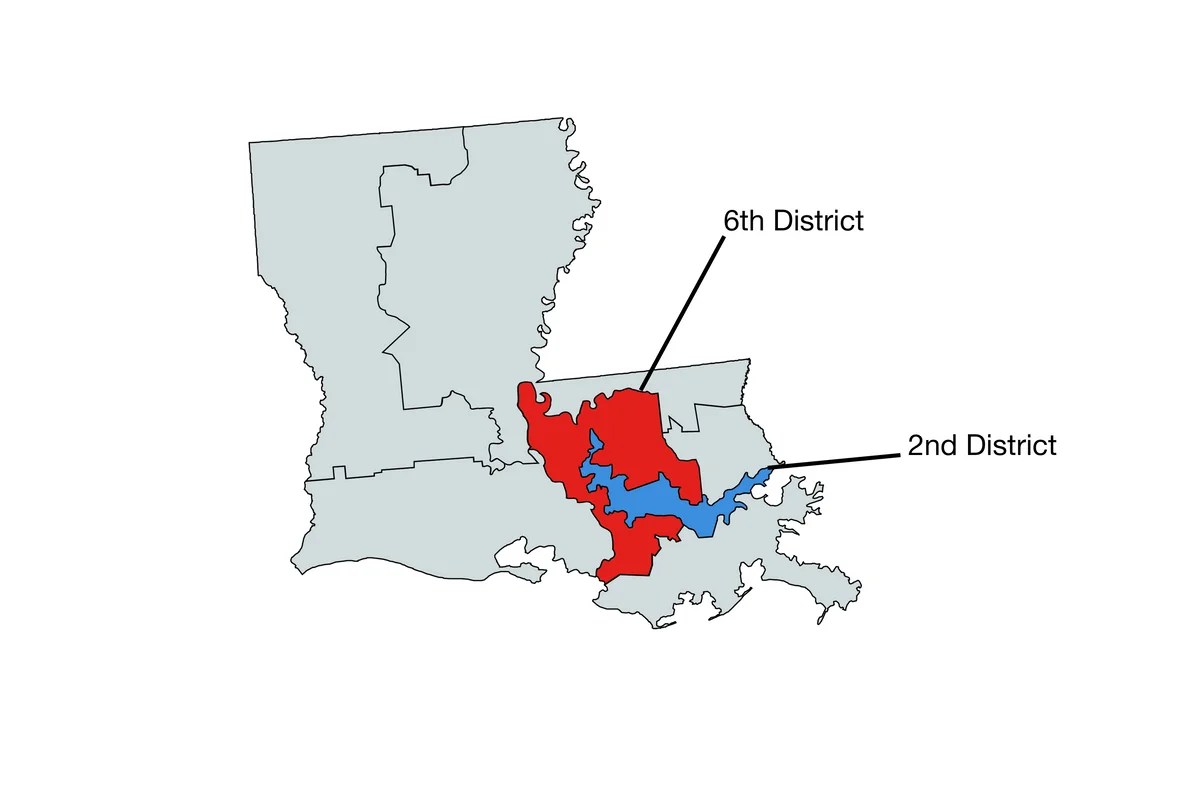
Gerrymandering is a political technique where voting districts are drawn to advantage one group over another. In practice, it looks incredibly silly. There are geographical districts that make no sense whatsover, snaking through territory with no other purpose than to bring power to some in-group. An example is an area having some large population of people that vote undesirably, according to a group in power. They can draw lines around them such that they are all districted together such that that district effectively gets “one vote”, instead of having that large population sway multiple districts. (The reverse, splitting them up, is also a tactic.) How it’s still legal is a disgrace.
I found Bruce Schneier’s observation and note on a solution interesting:
In 2009, I wrote:
There are several ways two people can divide a piece of cake in half. One way is to find someone impartial to do it for them. This works, but it requires another person. Another way is for one person to divide the piece, and the other person to complain (to the police, a judge, or his parents) if he doesn’t think it’s fair. This also works, but still requires another person—at least to resolve disputes. A third way is for one person to do the dividing, and for the other person to choose the half he wants.
The point is that unlike protocols that require a neutral third party to complete (arbitrated), or protocols that require that neutral third party to resolve disputes (adjudicated), self-enforcing protocols just work.
Bruce links to a paper where they “solve” this. At least in theory. It would work on paper, but politics is messy and it doesn’t really account for that. Still, sounds good to me!
- One party defines a map of equal-population contiguous districts.
- Then, the second party combines pairs of contiguous districts to create the final map.
It’s not obvious that this solution works. You could imagine that all the districts are defined so that one party has a slight majority. In that case, no combination of pairs will make that map fair. But real-world gerrymandering is never that clean. There’s “cracking,” where a party’s voters are split amongst several districts to dilute its power; and “packing,” where a party’s voters are concentrated in a single district so its influence can be minimized elsewhere. It turns out that this “define-combine procedure” works; the combining party can undo any damage that the defining party does—that the results are fair.
Related
🤘
ncG1vNJzZmibmKe2tK%2FOsqCeql6jsrV7kWlpbWdgZ3xxgI6gnKuqqaKur7DEq6Cnn18%3D